
Son of Thomas Mellon
1776 to 1800
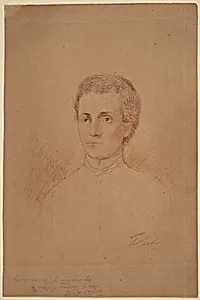
Medium
pen and brown ink and red crayon on brown wove paper
Dimensions
sheet: 27.7 × 18.3 cm (10 7/8 × 7 3/16 in.)
Classification
Drawing
Department
CG-W
Museum
National Gallery of Art, Washington, D.C.
Credit
Paul Mellon Collection
Accession Number
1964.24.5
Rights
Public Domain
Art Historical Context
Behold *Son of Thomas Mellon*, a delicate drawing attributed to an imitator of the renowned American portraitist Thomas Sully Created between 1776 and 1800, this work captures the refined likeness of its young subject using pen and brown ink combined with red crayon on brownove paper. Measuring just 27.7 × 18.3 cm, it exemplifies the intimate scale of preparatory sketches from the late 18th century, a period when such drawings served as studies for larger oil portraits, blending neoclassical precision with emerging romantic sensitivity. Thomas Sully (1783–1871), whose style this imitates, was a master of luminous portraits that flattered the elite, often employing fluid lines and subtle shading to convey character. Here, the artist's mixed-media technique—crisp ink outlines paired with the warm glow of red crayon—brings out the boy's thoughtful expression and soft features, highlighting period fashions like the curled hair and ruffled collar. The brown paper adds earthy depth, a clever choice for tonal modeling without full color. Housed in the National Gallery of Art's Paul Mellon Collection (Department CG-W), this drawing offers a glimpse into Anglo-American portraiture during the Revolutionary era's aftermath. It connects personal family history to broader artistic traditions, reminding us how sketches like this preserved legacies amid a young nation's growth. A charming window into 18th-century life!