
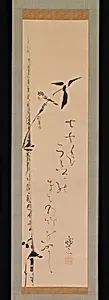
酒井抱一筆亀田鵬斎賛 竹雀図|Sparrow and Bamboo
ca. 1821
Medium
Hanging scroll; ink on paper
Dimensions
Image: 44 3/8 × 14 3/4 in. (112.7 × 37.5 cm) Overall with mounting: 68 1/4 × 14 3/4 in. (173.4 × 37.5 cm) Overall with knobs: 16 7/8 in. (42.9 cm)
Classification
Paintings
Culture & Period
Japan · Edo period (1615–1868)
Department
Asian Art
Museum
Metropolitan Museum of Art, New York, NY
Credit
Gift of Florence and Herbert Irving, 2015
Accession Number
2015.500.9.19
Rights
Public Domain
Tags
About this artwork
This hanging scroll features a solitary sparrow perched on a slender bamboo branch, executed in ink on paper through a collaboration between two prominent Edo-period artists. Sakai Hōitsu painted the image around 1821, while the distinguished calligrapher and Confucian scholar Kameda Bōsai added inscriptive text to the composition. In the narrow vertical format, the sparrow balances delicately on a bamboo branchlet, rendered with masterful tonal variation that contrasts the silvery tones of the ...
Art Historical Context
This exquisite hanging scroll, *Sparrow and Bamboo* (ca. 1821), showcases a delicate collaboration between two Edo-period masters: painter Sakai Hōitsu (1761–1829) and calligrapher Kameda Bōsai (1752–1826). Hōitsu rendered the image in masterful ink on paper, depicting solitary sparrow perched on slender bamboo branch. The narrow vertical format highlights tonal contrasts—the silvery bamboo stalk against dark leaves and joints—evoking a sense of poised tranquility amid nature's fragility. Hōitsu, a key figure in reviving the Rinpa school in Edo, drew from his samurai heritage and Rinpa forebears like Ogata Kōrin. After becoming a Buddhist priest in 1797, he refined depictions of natural motifs and seasons with elegant simplicity. His partner, Bōsai, a revered Confucian scholar and calligrapher, added poetic inscription, blending art and text in the literati tradition prized by elite patrons. As a monochromatic ink hanging scroll, the work exemplifies East Asian painting techniques, where subtle ink washes convey depth and emotion. During Japan's Edo period (1615–1868), such collaborations symbolized cultural sophistication, inviting viewers to contemplate harmony in simplicity. A gift to the Metropolitan Museum of Art, it captures the era's artistic brilliance.
About the Artist
Kameda Bōsai|Sakai Hōitsu (Japanese) · 1752 –1826
Japanese, 1752–1826