
Speculum Romanae Magnificentiae: Marforius
Medium
Engraving
Dimensions
sheet: 14 5/8 x 17 1/8 in. (37.2 x 43.5 cm) mount: 22 1/16 x 17 5/16 in. (56 x 44 cm)
Classification
Prints
Department
Drawings and Prints
Museum
Metropolitan Museum of Art, New York, NY
Credit
Harris Brisbane Dick Fund, 1941
Accession Number
41.72(2.100)
Rights
Public Domain
Tags
Art Historical Context
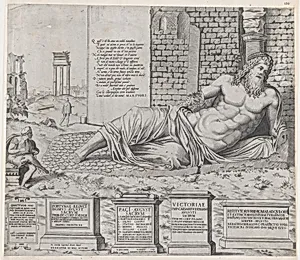
"Speculum Romanae Magniae: Marforius" is a striking 16th-century engraving Nicolas Beatrizet, after associated with publisher Antonio Lafreri, created around 1550. Part of the renowned *Speculum Romanae Magnificentiae—a vast anthology of over 500 prints documenting Rome's ancient monuments—this work captures the iconic Marforio statue, a ancient Roman marble sculpture depicting a bearded male figure, likely a river god or Oceanus. Measuring 14 5/8 x 17 1/8 inches on its sheet, the print exemplifies the Renaissance fascination with classical antiquity, serving as both artistic reproduction and scholarly record. Engraving, the medium here, allowed for precise, detailed lines incised into copper plates, enabling high-quality multiples that spread images of Rome's ruins across Europe. Beatrizet's skilled technique renders the sculpture's muscular form, flowing drapery, and pedestal with remarkable fidelity, highlighting its grandeur amid Renaissance rediscoveries. Published by Lafreri, these prints were collector's items for artists, architects, and travelers on the Grand Tour, fueling the revival of classical ideals in art and architecture. Today, housed in the Metropolitan Museum of Art's Drawings and Prints department (acquired via the Harris Brisbane Dick Fund in 1941), this piece invites us to marvel at Rome's enduring legacy. It bridges past and present, reminding visitors of how 16th-century innovators preserved antiquity for future generations.
About the Artist
Nicolas Beatrizet|Antonio Lafreri · 1515–1566
Nicolas Beatrizet, born around 1515 in Lunéville, Lorraine (then part of the Holy Roman Empire), emerged as one of the most prolific French engravers of the 16th century. Little is known about his early life and training, with no records of specific teachers or apprenticeships, though regional influences from German and Italian printmaking likely shaped his skills before he arrived in Rome around ...