
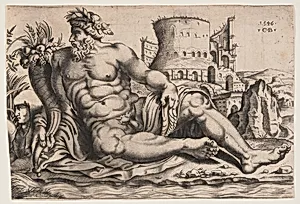
The River Nile
1546
Medium
Engraving on paper
Dimensions
Sheet (trimmed): 14.4 × 20.9 cm (5 11/16 × 8 1/4 in.)
Classification
engraving
Department
Prints and Drawings
Museum
Art Institute of Chicago
Accession Number
267884
Rights
Public Domain
Art Historical Context
Created in 1546 by the Flemish engraver Cornelis Bos, *The River Nile* exemplifies the growing fascination with classical geography and allegory during the Renaissance. Rendered as a detailed engraving on paper, the work measures just under 15 by 21 centimeters, a modest size typical of prints designed for easy circulation among collectors and scholars. Bos’s precise line work captures the flowing river as both a natural force and a symbolic figure, reflecting the period’s renewed interest in ancient myths and distant lands. Engraving was a transformative medium in the sixteenth century, allowing artists to reproduce intricate designs with remarkable clarity and distribute them across Europe. Unlike paintings or frescoes confined to palaces and churches, prints like this one reached a wider audience, helping to shape shared visual knowledge of history and science. Bos, active in the Low Countries, contributed to this vibrant print culture by translating complex subjects into accessible, finely crafted images. Today, this engraving resides in the Art Institute of Chicago’s Prints and Drawings department, where it offers visitors a window into how Renaissance artists blended artistic skill with intellectual curiosity about the world. Its intimate scale invites close looking, rewarding viewers with the subtle textures and rhythms that only hand-engraved lines can achieve.
About the Artist
Cornelis Bos · 1510–1556
Cornelis Bos (c. 1506/10–before 1555), a Netherlandish engraver, printseller, and publisher born in 's-Hertogenbosch, emerged as a pivotal figure in the Antwerp print trade during the mid-16th century. His early life remains sparsely documented, with no records of formal training or mentors, though he was active in Antwerp by 1537, producing his earliest known engraving, *Prudence and Justice*, af...