
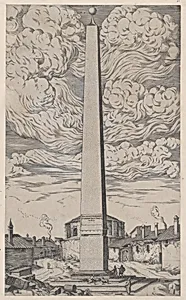
Speculum Romanae Magnificentiae: The Vatican Obelisk
16th century
Medium
Engraving
Dimensions
sheet: 19 5/16 x 11 5/8 in. (49 x 29.5 cm) mount: 22 1/8 x 16 3/4 in. (56.2 x 42.6 cm)
Classification
Prints
Department
Drawings and Prints
Museum
Metropolitan Museum of Art, New York, NY
Credit
Harris Brisbane Dick Fund, 1941
Accession Number
41.72(1.111)
Rights
Public Domain
Tags
Art Historical Context
Behold the *Speculum Romanae Magnificentiae: The Vatican Obelisk*, a captivating 16th-century engraving from the Metropolitan Museum of Art's Drawings and Prints collection. Part of Antonio Lafreri's influential *Speculum Romanae Magnificentiae*—Latin for "Mirror of Roman Magnificence"—this print captures the iconic Vatican Obelisk, an ancient Egyptian monument that symbolized Rome's enduring grandeur. Lafreri, a prominent publisher in Renaissance Rome, assembled this celebrated series of over 500 engravings, allowing viewers across Europe to marvel at the city's ancient wonders without leaving home. Crafted anonymously but issued under Lafreri's imprint, the artwork exemplifies the precision of 16th-century engraving techniques. Fine lines and intricate details on the 19 5/16 x 11 5/8-inch sheet convey the obelisk's towering scale amid St. Peter's Square, highlighting its 1586 re-erection by Domenico Fontana under Pope Sixtus V—a feat of engineering that moved the 320-ton relic from the Circus of Nero. This print not only documents a pivotal moment in papal urban renewal but also reflects the Renaissance obsession with antiquity, bridging classical Egypt and imperial Rome. As a cultural artifact, it fueled the Grand Tour era, inspiring artists, architects, and travelers. Acquired through the Harris Brisbane Dick Fund in 1941, it invites us to ponder Rome's layered history through the lens of masterful printmaking.
About the Artist
Anonymous|Antonio Lafreri
In the vast tapestry of art history, "Anonymous" stands not as a singular individual but as a collective designation for countless unidentified creators whose works have endured across millennia. These artists, spanning prehistoric cave painters to medieval illuminators and folk craftsmen, produced the foundational layers of human visual culture. Prior to the Renaissance, when individual fame emer...