
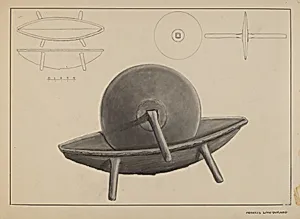
Spice Grinder
c. 1937
Medium
graphite and pen and ink on paperboard
Dimensions
overall: 22.8 x 30.5 cm (9 x 12 in.)
Classification
Index of American Design
Department
CG-W
Museum
National Gallery of Art, Washington, D.C.
Credit
Index of American Design
Accession Number
1943.8.11406
Rights
Public Domain
Art Historical Context
**Spice Grinder** by Francis Law Durand, created around 1937, captures the humble elegance of an everyday American kitchen tool through meticulous graphite and pen-and-ink drawing on paperboard. Measuring 9 x 12 inches, this work is part of the *Index of American Design*, a ambitious Federal Art Project under the Works Progress Administration (WPA) during the Great Depression. Launched in 1935, the Index employed artists across the U.S. to document folk art, crafts, and decorative objects, preserving a visual record of the nation's material culture before it faded into obscurity. Durand's rendering highlights the spice grinder's functional beauty—likely a wooden or metal device with intricate turnings and ergonomic form—showcasing the craftsmanship of early American artisans. The use of graphite for shading and fine pen lines for crisp details exemplifies the Index's photorealistic style, blending technical precision with artistic sensitivity. This technique not only immortalizes the object's textures and proportions but also evokes the domestic life of past generations. Housed in the National Gallery of Art, this drawing underscores the cultural importance of ordinary items in shaping American identity. It reminds us how WPA initiatives like the Index supported artists while safeguarding heritage, offering visitors a window into the ingenuity of everyday design.
About the Artist
Francis Law Durand · 1855–present
**Francis Law Durand (1906–1995)** Born on March 31, 1906, in Mount Holly, New Jersey, Francis Law Durand emerged as a skilled American draftsman and artist during the Great Depression era. Little is known about his early life or formal training, as biographical details remain sparsely documented beyond his professional output. By 1935, he was employed by the Works Progress Administration (WPA), ...