
Spoon
Unknown Artist
5th–6th century
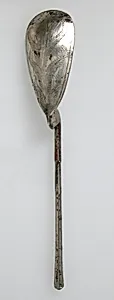
Medium
Silver
Dimensions
Overall: 9 1/2 x 1 3/4 x 15/16 in. (24.2 x 4.5 x 2.4 cm) shovel: 3 3/8 x 1 3/4 x 7/16 in. (8.6 x 4.5 x 1.1 cm)
Classification
Metalwork-Silver
Culture
Byzantine
Department
Medieval Art
Museum
Metropolitan Museum of Art, New York, NY
Credit
Rogers Fund, 1913
Accession Number
13.42.1c
Rights
Public Domain
Art Historical Context
This elegant silver spoon from the 5th–6th offers a glimpse into the refined world of early Byzantine daily life. Crafted during the height of the Byzantine Empire—centered in Constantinople after the fall of the Western Empire—it measures an impressive 9½ inches overall, with a broad shovel-shaped bowl about 3⅜ inches long. Such spoons were essential utensils for the elite, used in dining, religious rituals, or even as gifts, showcasing the era's mastery of metalworking. Byzantine silverwork blended Roman engineering with Eastern opulence, often featuring intricate chasing, engraving, or gilding—though this example highlights the purity and durability of the medium itself. As a product of a culture that bridged antiquity and the medieval world, it reflects the empire's prosperity and cultural continuity, where even humble objects like spoons embodied artistic precision. Acquired through the Rogers Fund in 1913 and housed in the Metropolitan Museum of Art's Medieval Art department, this anonymous masterpiece invites us to appreciate the unsung artisans who crafted tools that outlasted empires. (178 words)