
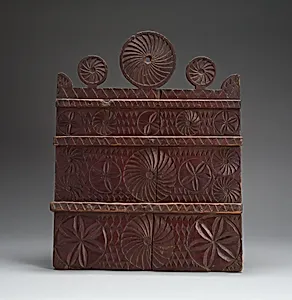
Spoon Rack
1750–1850
Medium
White pine
Dimensions
53.4 × 41.3 × 6 cm (21 × 16 1/4 × 2 3/8 in.)
Classification
wood
Department
Arts of the Americas
Museum
Art Institute of Chicago
Accession Number
56172
Rights
Public Domain
Art Historical Context
Nestled in the Art Institute of Chicago's Arts the Americas collection, this unassuming yet charming *Spoon Rack* from 1750–1850 exemplifies the everyday craftsmanship of early American life. Crafted from white pine—a lightweight, readily available wood abundant in colonial New England—this wall-mounted piece measures a modest 53.4 × 41.3 × 6 cm. Its simple, rectangular form with pierced slots and decorative cutouts was designed to hold and display a household's prized spoons, often made of pewter or wood, keeping them organized and visible in the kitchen or dining area. Produced during a period spanning the late colonial era through the early republic, the rack reflects the practical ingenuity of anonymous makers who blended utility with subtle ornamentation. White pine's soft grain allowed for intricate shaping using basic tools like saws, chisels, and drills, resulting in a functional object that doubled as homely decoration. Such racks were common in rural and urban homes alike, symbolizing thrift, hospitality, and the self-sufficient spirit of American settlers. Today, this artifact highlights the artistic value of vernacular woodwork, often overlooked in favor of fine art. By preserving it, the museum celebrates the unsung contributions of everyday artisans, offering visitors a tangible glimpse into 18th- and 19th-century domestic culture.