
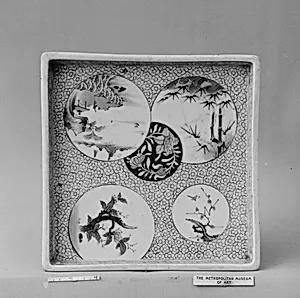
Square Tray
Unknown Artist
1720
Medium
White porcelain decorated with blue under the glaze (Arita ware, Imari type)
Dimensions
W. 8 3/4 in. (22.2 cm); D. 7/8 in. (2.2 cm)
Classification
Ceramics
Culture & Period
Japan · Edo period (1615–1868)
Department
Asian Art
Museum
Metropolitan Museum of Art, New York, NY
Credit
Gift of Charles Stewart Smith, 1893
Accession Number
93.3.466
Rights
Public Domain
Tags
Art Historical Context
This elegant square tray, crafted around 1720 during Japan's Edo period (1615–1868), exemplifies the mastery of Arita ware porcelain from the Imari kilns in Saga Prefecture. Made of fine white porcelain decorated with cobalt blue under the glaze, it measures 8 3/4 inches wide and just 7/8 inch deep, perfect for serving sweets or as a decorative tray in a tea ceremony setting. The underglaze technique—where blue pigment is applied before a transparent glaze and fired at high temperatures—ensured durable, vibrant designs that wouldn't fade, a hallmark of Japanese export porcelain prized in Europe at the time. The tray's motifs of flowers and bamboo, rendered in delicate blue washes, carry deep cultural symbolism: flowers evoke seasonal beauty and transience, while bamboo represents resilience and purity. Arita potters, inspired by Chinese blue-and-white wares, perfected Imari-style pieces for both domestic use and global trade, blending functionality with artistry. This example, gifted to the Metropolitan Museum of Art in 1893 by Charles Stewart Smith, highlights the Edo era's porcelain boom, when Japan became a powerhouse in ceramics innovation. Visitors will appreciate its subtle sophistication—a window into 18th-century Japanese aesthetics where everyday objects doubled as philosophical statements.