
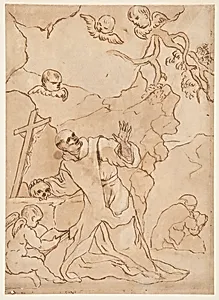
St. Bruno in Ecstasy
Classification
figures
Department
Smithsonian Collection
Museum
Smithsonian American Art Museum
Credit
Gift of Mrs. Grafton H. Pyne
Accession Number
1948-118-31
Rights
Public Domain
About this artwork
Research in Progress
Art Historical Context
**St. Bruno in Ec** by Marcantonio Franceschini (164–1729), a Italian painter of the late Baroque period, captures a moment of profound spiritual rapture. Franceschini, based in Bologna and influenced by the Carracci family's legacy, specialized in dynamic religious scenes filled with emotion and movement. Saint Bruno, the 11th-century founder of the Carthusian monastic order, is portrayed here in ecstasy—a common motif in Catholic art symbolizing divine union and mystical contemplation. Though dated to 1800–20, well after the artist's death, this work reflects his enduring stylistic impact, possibly as a studio production or later attribution. Classified as a figure study and housed in the Smithsonian American Art Museum's collection (gift of Mrs. Grafton H. Pyne), the painting exemplifies Baroque techniques emphasizing dramatic lighting, expressive poses, and fervent spirituality. These elements aimed to evoke awe and devotion in viewers, aligning with the Counter-Reformation's push for emotionally charged religious imagery. With ongoing research into its medium and precise origins, *St. Bruno in Ecstasy* invites us to ponder the saint's life of asceticism and the timeless allure of Baroque ecstasy in art. (178 words)