
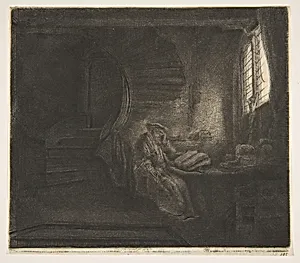
St. Jerome in a Dark Chamber
Medium
Etching, engraving, and drypoint; second of three states
Dimensions
Sheet (Trimmed): 6 in. × 6 15/16 in. (15.3 × 17.6 cm)
Classification
Prints
Department
Drawings and Prints
Museum
Metropolitan Museum of Art, New York, NY
Credit
Gift of Felix M. Warburg and his family, 1941
Accession Number
41.1.56
Rights
Public Domain
Tags
Art Historical Context
In the hushed glow of Rembrandt van Rijn's *St. Jerome in a Chamber* (1642), the Dutch Baroque master captures the saintly scholar in profound contemplation. Created during Rembrandt's prolific Amsterdam years, this intimate print depicts St. Jerome, the 4th-century Bible translator patron saint of scholars, immersed in a dimly lit room symbolizing spiritual introspection. composition draws viewers into Jerome's world of study and penance, a recurring motif in Renaissance and Baroque art that underscores themes of mortality and divine wisdom. Rembrandt's genius shines through his masterful use of etching, engraving, and drypoint in this second state of three—a testament to his innovative printmaking. These techniques allowed for rich textures and dramatic chiaroscuro, with light piercing the darkness to highlight Jerome's furrowed brow and scattered objects like books and a skull. At just 6 × 6 15/16 inches, the trimmed sheet intensifies its meditative focus, making it a collector's gem now housed in the Metropolitan Museum of Art's Drawings and Prints department, gifted by Felix M. Warburg and family in 1941. This work exemplifies Rembrandt's ability to infuse prints with the emotional depth of paintings, bridging religious devotion and artistic experimentation in 17th-century Europe. A perfect invitation to pause and reflect amid the museum's treasures.
About the Artist
Rembrandt (Rembrandt van Rijn) · 1606–1669
Rembrandt Harmenszoon van Rijn (1606–1669) stands as one of the greatest visual artists in the history of Western art and the most important Dutch painter of the 17th century. Born in Leiden to a prosperous miller's family, Rembrandt transformed painting through his revolutionary use of light and shadow, his psychological depth in portraiture, and his elevation of etching to a fine art. His approx...