
St. John the Baptist in the Desert
1513
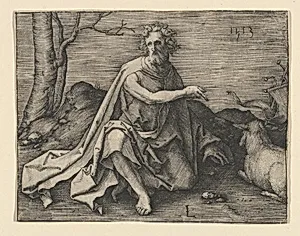
Medium
Engraving
Classification
Prints
Department
Drawings and Prints
Museum
Metropolitan Museum of Art, New York, NY
Credit
Harris Brisbane Dick Fund, 1930
Accession Number
30.55.8
Rights
Public Domain
Tags
Art Historical Context
In the hushed galleries of the Metropolitan Museum of's Drawings and Prints department, Lucas vanden's *St. John the Baptist in the Desert* (151) captivates with its intricate engraving. This Dutch master's depiction of the biblical saint—clad in animal skins, staff in hand, amid a stark wilderness—evokes the prophet's solitary life of ascetic preparation for Christ. Acquired through the Harris Brisbane Dick Fund 1930, the print exemplifies the Northern Renaissance's fusion of spiritual depth and technical virtuosity. Lucas van Leyden, a prodigy who died young at 39, revolutionized printmaking in early 16th-century Netherlands. His engravings, like this one, rivaled paintings in detail, using fine lines to conjure textures of rocky deserts, distant landscapes, and the saint's weathered form. Engraving's durability allowed wide circulation, spreading Renaissance humanism and religious iconography across Europe during the Reformation's stirrings. This work's cultural resonance lies in its portrayal of St. John as a symbol of repentance and wilderness purity, a motif rooted in scripture and popular in devotional art. Van Leyden's masterful light and shadow draw viewers into contemplative isolation, inviting modern audiences to ponder enduring themes of faith amid nature's vastness.
About the Artist
Lucas van Leyden · 1484–1533
Lucas van Leyden (1494–1533) was a Dutch painter and printmaker who stands among the greatest engravers of the Northern Renaissance. Born in Leiden as either Lucas Hugensz or Lucas Jacobsz, he lived and worked primarily in his native city, achieving international renown that rivaled the German master Albrecht Dürer. Lucas van Leyden revolutionized Netherlandish printmaking and was among the first...