
St. John the Evangelist
c. 1590
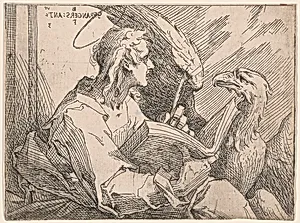
Medium
Etching on ivory laid paper
Dimensions
Sheet (trimmed): 15.3 × 20.5 cm (6 1/16 × 8 1/8 in.)
Classification
etching
Department
Prints and Drawings
Museum
Art Institute of Chicago
Accession Number
264832
Rights
Public Domain
Art Historical Context
Bartholomaeus Spranger’s *St. John the Evangelist*, created around 1590, offers a compelling example of Northern Mannerist printmaking. Spranger, a Flemish artist who spent much of his career at court of Emperor Rudolf II Prague, was renowned for his elegant, elongated figures and refined compositions. This small etching captures the evangelist in a moment of quiet contemplation, reflecting the period’s interest in expressive religious imagery that combined spiritual depth with graceful, stylized forms. The work’s medium—an etching on ivory laid paper—highlights the technical advancements of late sixteenth-century printmaking. Etching allowed artists like Spranger to achieve delicate lines and subtle tonal variations, making intricate designs more accessible than paintings. Measuring just over six by eight inches, the trimmed sheet suggests it was intended for private devotion or inclusion in collectors’ albums, a common practice that helped spread Mannerist aesthetics across Europe. Housed in the Art Institute of Chicago’s Department of Prints and Drawings, this piece underscores the cultural importance of reproductive prints in disseminating both artistic innovation and religious themes during the Counter-Reformation. Its intimate scale invites close viewing, revealing the careful craftsmanship that made such works treasured by audiences of the time.
About the Artist
Bartholomaeus Spranger · 1546–1611
Bartholomaeus Spranger was born on 21 March 1546 in Antwerp, Habsburg Netherlands, as the third son of trader Ioachim Spranger and Anna Roelandtsinne. He began his artistic training in Antwerp, apprenticing for 18 months under landscape painter Jan Mandijn, briefly with Frans Mostaert after Mandijn's death, and then spending two years studying followed by two more in the workshop of Cornelis van D...