
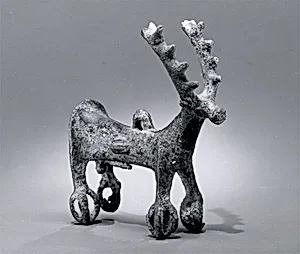
Stag pendant with bell feet
Unknown Artist
ca. early 1st millennium BCE
Medium
Bronze
Dimensions
3.31 x 3.15 in. (8.41 x 8 cm)
Classification
Metalwork-Ornaments
Period
Iron Age
Department
Ancient Near Eastern Art
Museum
Metropolitan Museum of Art, New York, NY
Credit
Gift of Mr. and Mrs. Nathaniel Spear Jr., 1978
Accession Number
1978.514.23
Rights
Public Domain
Tags
Art Historical Context
This exquisite bronze stag pendant, measuring just over 3 inches across, hails from the early Iron Age in the Ancient Near East, around the early 1st millennium BCE Crafted as a delicate ornament, it depicts a stylized stag standing on feet shaped like tiny bells—likely designed to jingle softly with movement, adding a playful auditory charm to its wearer's attire. The lost-wax casting technique common in the period allowed for such intricate details in a small scale, showcasing the advanced metalworking skills of ancient artisans. From the Iron Age (ca. 1200–500 BCE), this piece reflects the cultural vibrancy of regions like Anatolia, Mesopotamia, or the Levant, where deer motifs symbolized speed, grace, and perhaps divine protection or fertility. Stags often appeared in elite jewelry, amulets, or horse trappings, blending functionality with symbolism in daily life and ritual. Today, gifted to the Metropolitan Museum of Art in 1978, this rare survivor offers a glimpse into the sophisticated tastes of Iron Age societies, where even everyday ornaments carried deeper meaning. Imagine it swaying from a necklace, its bells tinkling like echoes of ancient footsteps!