
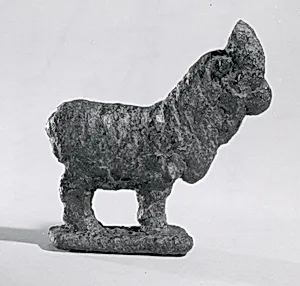
Figurine
Unknown Artist
ca. late 3rd–early 2nd millennium BCE
Medium
Copper alloy
Dimensions
1.89 in. (4.8 cm)
Classification
Metalwork-Sculpture
Culture & Period
Bactria-Margiana Archaeological Complex · Bronze Age
Department
Ancient Near Eastern Art
Museum
Metropolitan Museum of Art, New York, NY
Credit
Gift of Steven D. Robinson, 1981
Accession Number
1981.448.18
Rights
Public Domain
Tags
Art Historical Context
This petite copper alloy figurine, just 1.89 inches tall, hails from the Bactria-Margiana Complex (BMAC)— mysterious Bronze Age civilization flourishing Central Asia around the late 3rd to early 2nd millennium BCE. Discovered in the region spanning modern-day Turkmenistan, Uzbekistan, and Afghanistan, the BMAC was renowned for its urban centers, intricate crafts, and early mastery of metallurgy. This animal figurine, likely representing a creature symbolic to the culture, exemplifies the period's innovative use of copper alloys, an early form of bronze that marked a technological leap from stone tools to durable metalwork. Crafted with remarkable precision for its diminutive size, the figurine showcases the BMAC artisans' skill in casting and modeling metal, techniques that supported trade networks stretching from Mesopotamia to the Indus Valley. Such small sculptures were probably votive offerings, amulets, or ritual objects, reflecting the society's deep connection to the animal world—evident in its zoomorphic form. Animals in BMAC art often symbolized fertility, protection, or divine forces, underscoring a worldview intertwined with nature and the supernatural. Today, this rare survivor graces the Metropolitan Museum of Art's Ancient Near Eastern Art department, a gift from Steven D. Robinson in 1981. It invites us to ponder the ingenuity of a lost civilization, bridging the ancient steppes to our modern curiosity.