
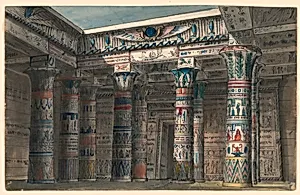
Stage Design, Egyptian Courtyard
early 19th century
Classification
theater
Department
Smithsonian Collection
Museum
Smithsonian American Art Museum
Credit
Museum purchase through gift of various donors and from Eleanor G. Hewitt Fund
Accession Number
1938-88-280
Rights
Public Domain
About this artwork
Research in Progress
Art Historical Context
**Stage Design, Egyptian Courtyard** by Romolo Achille Liver (Italian, 1809–1872) captures the allure of ancient Egypt in an early 19th-century theatrical vision. a scenic design for the stage, artwork likely served as a backdrop for operas, plays, ballets, immersing audiences in a fantastical Egyptian courtyard. Liverani, a versatile Italian artist, contributed to the era's booming theater scene, where elaborate sets transformed ordinary stages into exotic worlds. The early 1800s marked a peak in *Egyptomania*, sparked by Napoleon's 1798–1801 Egyptian campaign and the discovery of treasures like the Rosetta Stone. This fervor influenced European arts, blending neoclassical precision with romantic exoticism. Liverani's design reflects this trend, evoking monumental architecture—think towering pylons, hieroglyphic walls, and lush palm-shaded spaces—to heighten dramatic tension and transport viewers to the Nile's banks. Housed in the Smithsonian American Art Museum's theater collection (museum purchase via donors and the Eleanor G. Hewitt Fund), this piece highlights the artistry behind the curtain. Though research continues, it underscores stage design's role in cultural storytelling, merging history, fantasy, and innovation for live performance magic.