
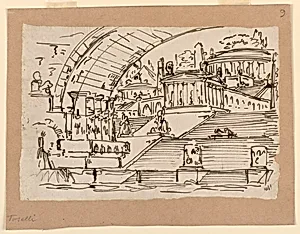
Stage Design, Imaginary City
early 19th century
Classification
theater
Department
Smithsonian Collection
Museum
Smithsonian American Art Museum
Credit
Museum purchase through gift of various donors and from Eleanor G. Hewitt Fund
Accession Number
1938-88-401
Rights
Public Domain
About this artwork
Research in Progress
Art Historical Context
**Stage Design, Imaginary City** by Angelo Toselli (ca. 1765?–1826) invites visitors into the enchanting world of early 19-century theater. Created during a golden age of European opera and dramatic spectacle, this work exemplifies Toselli's talent as an Italian architect and designer. Though the exact medium remains unidentified amid ongoing research, it captures imaginative urban panorama likely intended for the stage, blending architectural fantasy with theatrical illusion to transport audiences to unrealized realms. In the early 1800s, stage designs like this one were pivotal innovations, employing advanced perspective techniques to mimic grand cities and landscapes on flat canvases. Toselli's piece reflects the neoclassical influences of his time, where architects doubled as scene painters to evoke awe in dimly lit theaters. Held in the Smithsonian American Art Museum's collection—acquired through museum purchases and the Eleanor G. Hewitt Fund—it highlights the fusion of art and performance that defined cultural life across Europe. This "Imaginary City" underscores theater's role in escapism and storytelling, offering a window into how 19th-century designers crafted dreams from paint and ingenuity. As research progresses, it promises deeper insights into Toselli's contributions to scenic art.