
Stage Design
1751 to 1775
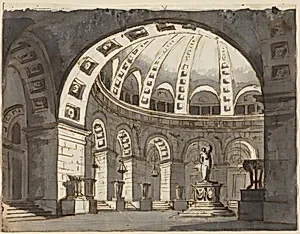
Medium
pen and brown ink with gray wash over graphite on laid paper
Dimensions
overall: 16.5 x 21.3 cm (6 1/2 x 8 3/8 in.)
Classification
Drawing
Department
CG-E
Museum
National Gallery of Art, Washington, D.C.
Credit
Gift of William B. O'Neal, in Honor of the 50th Anniversary of the National Gallery of Art
Accession Number
1991.150.28
Rights
Public Domain
Art Historical Context
Step into the enchanting world of 18th Italian theater with *Stage Design* by Gasparo Galliari (1744–1789), a master scenographer from a renowned family of stage designers in Milan and Turin. between 1751 and 1775, this drawing captures the dramatic flair of opera and ballet productions during the Baroque-Rococo era, when elaborate scenery transformed stages into illusory palaces, gardens, and seascapes. Galliari's work supported the thriving operatic culture of northern Italy, where families like his supplied theaters such as La Scala with breathtaking backdrops that blurred the line between reality and fantasy. Rendered in pen and brown ink with gray wash over graphite on laid paper (16.5 x 21.3 cm), the piece exemplifies preparatory techniques for theatrical architecture. Graphite sketches provided the foundational perspective lines, inked contours added precision, and subtle gray washes evoked depth and atmosphere—methods that allowed designers to pitch grand visions to patrons and machinists. These modest drawings, often the sole survivors of ephemeral sets, offer invaluable insight into the engineering of illusionism, or *quadratura*, a Galliari specialty. Today, this gem graces the National Gallery of Art, gifted by William B. O'Neal to celebrate the museum's 50th anniversary. It reminds us how paper-bound sketches fueled Europe's cultural spectacles, inviting us to imagine the gasps of audiences as curtains rose on Galliari's creations.