
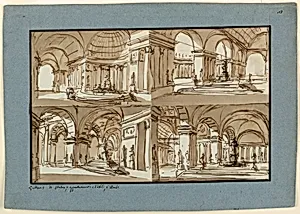
Stage Design of a Palace Interior
early 19th century
Classification
theater
Department
Smithsonian Collection
Museum
Smithsonian American Art Museum
Credit
Museum purchase through gift of various donors and from Eleanor G. Hewitt Fund
Accession Number
1938-88-126
Rights
Public Domain
About this artwork
Research in Progress
Art Historical Context
Giuseppe Barberi’s “Stage Design of a Palace Interior” captures the grandeur of early-nineteenth-century European theater. Created by the Italian artist and architect (1746–1809) late in his career, the drawing envisions an opulent palace setting intended to transport audiences during performances of opera or drama. Such designs were essential to the period’s lavish productions, where painted scenery helped evoke the splendor of royal halls and classical antiquity on stage. Barberi worked within the neoclassical movement, favoring symmetry, classical columns, and dramatic perspective to heighten theatrical illusion. Although the exact medium remains unrecorded, the work’s classification as theater design highlights its practical role in shaping audience experience. Acquired by the Smithsonian American Art Museum through the Eleanor G. Hewitt Fund, the piece preserves a fleeting moment of artistic planning that once brought imagined worlds vividly to life for theatergoers of the time.