
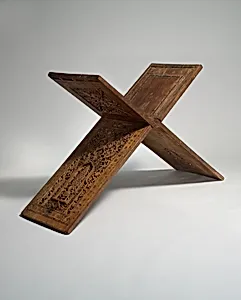
Stand for a Qur'an Manuscript
dated A.H. 761/1360 CE
Medium
Wood (teak); carved, painted, and inlaid
Dimensions
W. (when closed) 16 1/8 in. (41 cm) H. (when closed) 51 1/4 in. (130.2 cm) Dimensions when open: H. 45 in. (114.3 cm) W. 50 in. (127 cm) D. 16 1/2 in. (41.9 cm)
Classification
Wood
Department
Islamic Art
Museum
Metropolitan Museum of Art, New York, NY
Credit
Rogers Fund, 1910
Accession Number
10.218
Rights
Public Domain
Tags
Art Historical Context
This exquisite teak wood stand, created in 1360 CE by the artisan Zain(?) Hasan Sulaiman Isfahani, was designed to hold and display a large Qur'an manuscript during recitations or study. Originating from Isfahan in present-day Iran during the Ilkhanid period, such stands—known as rahle—elevated the sacred text both literally and symbolically in mosques and madrasas. The piece's folding design, which opens to nearly four feet wide, allowed it to support heavy illuminated volumes while showcasing the woodworker's skill. Crafted through carving, painting, and inlay techniques, the stand features delicate floral motifs and Arabic inscriptions that reflect the refined aesthetics of 14th-century Persian Islamic art. Teak, likely imported from South Asia, highlights extensive trade networks and the value placed on durable, aromatic woods for religious objects. Its survival with a clear date and possible maker's name makes it a rare document of medieval craftsmanship. Acquired by the Metropolitan Museum in 1910, this stand offers visitors a tangible connection to the reverence for the Qur'an in Islamic culture, where functional objects became vehicles for spiritual beauty and devotion.