
Stand (part of a service)
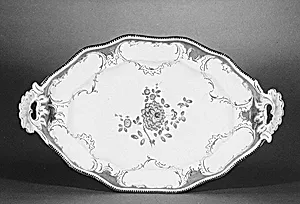
Medium
Hard-paste porcelain
Dimensions
9 15/16 × 16 1/2 in. (25.2 × 41.9 cm)
Classification
Ceramics-Porcelain
Culture
German, Meissen
Department
European Sculpture and Decorative Arts
Museum
Metropolitan Museum of Art, New York, NY
Credit
The Charles E. Sampson Memorial Fund, 1965
Accession Number
65.134
Rights
Public Domain
Tags
Art Historical Context
This elegant porcelain stand, crafted by the renowned Meissen Manufactory 1761, forms of a luxurious service likely intended for dining or tea rituals. Measuring 9 15/16 × 16 1/2 inches, it exemplifies the German factory's mastery of hard-paste porcelain—a durable, translucent material that revolutionized European ceramics after its invention at Meissen around 1710. This breakthrough allowed artisans to rival the prized Chinese imports that had captivated European courts for centuries. Meissen porcelain flourished under royal patronage, particularly during the Rococo era, when opulent tablewares became symbols of wealth and refinement. The stand's floral motifs, vividly painted and possibly accented with gilding, reflect the period's delight in nature's abundance, rendered with meticulous detail that highlights the factory's innovative techniques like underglaze painting and intricate molding. Housed in the Metropolitan Museum of Art's European Sculpture and Decorative Arts collection, this piece—acquired through The Charles E. Sampson Memorial Fund in 1965—offers a glimpse into 18th-century luxury, where functionality met artistry in the grand homes of Europe's elite.
About the Artist
Meissen Manufactory · 1710–present
The Meissen Manufactory, established on June 6, 1710, by Augustus the Strong, Elector of Saxony and King of Poland, marked the dawn of true hard-paste porcelain production in Europe. Nestled at Albrechtsburg Castle in Meissen near Dresden, the Royal Polish and Electoral Saxon Porcelain Manufactory arose from alchemical experiments begun in 1708 by physicist Ehrenfried Walther von Tschirnhaus and p...