
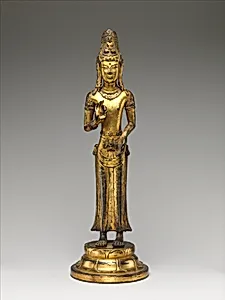
大理國(十二世紀) 青銅鎏金觀音菩薩像|Bodhisattva Avalokiteshvara (Guanyin)
Unknown Artist
12th century
Medium
Gilt arsenical bronze; lost-wax cast
Dimensions
H. 20 3/4 in. (52.7 cm); W. 6 1/2 in. (16.5 cm); Diam. (base) 6 1/2 in. (16.5 cm)
Classification
Sculpture
Culture & Period
China · Dali kingdom (938–1253)
Department
Asian Art
Museum
Metropolitan Museum of Art, New York, NY
Credit
Gift of Abby Aldrich Rockefeller, 1942
Accession Number
42.25.28
Rights
Public Domain
Tags
Art Historical Context
This exquisite gilt bronze statue of the Bodhisattva Avalokhvara, known as Guanyin in Chinese, hails from the Dali Kingdom 12th-century China—a vibrant Buddhist realm in present-day Yunnan that flourished from 938 to 1253. Standing about 20¾ inches tall, the serene figure embodies Guanyin's role as the compassionate savior, often depicted with a gentle expression and flowing robes that evoke grace and accessibility. Crafted during a golden age of regional Buddhist art, it reflects the kingdom's unique fusion of Han Chinese, Tibetan, and Southeast Asian influences, making it a rare survivor from this short-lived yet culturally rich dynasty. The sculpture's medium—arsenical bronze with gilding, cast using the sophisticated lost-wax technique—highlights advanced metallurgical skills. Arsenical bronze lent a durable, silvery sheen, while the thin gold overlay created a radiant, divine glow, symbolizing enlightenment. The lost-wax method allowed for intricate details, like the bodhisattva's jewelry and lotus base, capturing fluid drapery and a sense of ethereal movement. A generous gift to the Metropolitan Museum of Art from Abby Aldrich Rockefeller in 1942, this masterpiece invites visitors to contemplate Guanyin's enduring message of mercy amid Dali's turbulent history, conquered by the Mongols in 1253. It stands as a testament to the kingdom's artistic devotion to Buddhism.