
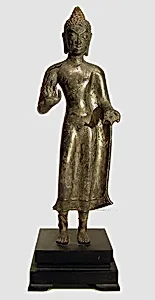
Standing Buddha
Unknown Artist
8th–9th century
Medium
Silver
Dimensions
H. 11 1/4 in. (28.6 cm); W. 4 in. (10.2 cm); D. 2 1/2 in. (6.4 cm)
Classification
Sculpture
Culture & Period
Thailand · Mon-Dvaravati period
Department
Asian Art
Museum
Metropolitan Museum of Art, New York, NY
Credit
Gift of Muneichi Nitta, 2004
Accession Number
2004.142.1
Rights
Public Domain
Tags
Art Historical Context
This exquisite Standing Buddha, crafted in silver during Thailand's Mon-Dvaravati period (8th–9th century stands as a luminous testament to early Southeast Asian Buddhism. Measuring just 11¼ inches tall, this petite sculpture from the Mon people of central Thailand captures the serene poise of the Buddha in a standing posture, a pose evoking protection and accessibility in Theravada traditions. The Mon-Dvaravati era (circa 6th–11th century) marked a flourishing of Buddhist art influenced by Indian styles, blending local motifs with spiritual iconography to adorn temples and shrines. The choice of silver as a medium underscores its rarity and prestige—far less common than the period's typical stone or terracotta works, suggesting it was a high-status devotional object, perhaps for elite patrons or portable worship. Artisans employed lost-wax casting techniques, achieving a smooth, reflective surface that would have gleamed in temple candlelight, symbolizing the Buddha's divine radiance (prabha). Its compact dimensions (4 inches wide, 2½ inches deep) imply personal or processional use, highlighting the intimate role of such icons in daily devotion. Housed in the Metropolitan Museum of Art's Asian Art Department through a 2004 gift from Muneichi Nitta, this sculpture offers a window into Dvaravati's cultural crossroads, where Mon ingenuity fused with Buddhist ideals to shape Thailand's artistic legacy. Visitors are invited to marvel at its enduring grace.