
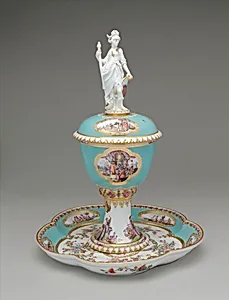
Standing cup with cover and stand
Medium
Hard-paste porcelain
Dimensions
Overall, cup: 15 1/2 x 6 1/4 in. (39.4 x 15.9 cm); Overall, stand: 1 1/2 x 11 1/2 in. (3.8 x 29.2 cm)
Classification
Ceramics-Porcelain
Culture
German, Meissen
Department
European Sculpture and Decorative Arts
Museum
Metropolitan Museum of Art, New York, NY
Credit
Gift of R. Thornton Wilson, in memory of his brother, Orme Wilson, 1966
Accession Number
66.63a–c
Rights
Public Domain
Tags
Art Historical Context
This elegant standing cup with cover and, crafted by the renowned Meissen Manufactory around 1735, exemplifies pinnacle of early European porcelain artistry. Modeled by master sculptor Johann Joachim Känd, a key figure at Meissen, it is made from hard-paste porcelain—a breakthrough material developed in Germany in 1710 that finally rivaled the translucent, durable wares long imported from China. Measuring an impressive 15½ inches tall for the cup alone, with a sprawling 11½-inch stand, this piece was designed as luxurious tableware for aristocratic dining. Adorned in the fashionable chinoiserie style, the cup features whimsical scenes of men and women engaged in musical pursuits, blending European imagination with imagined Chinese motifs—a Rococo-era craze that romanticized the exotic East. Kändler's intricate modeling brings these human figures to life with fluid poses and delicate details, showcasing Meissen's technical virtuosity in molding, glazing, and painting underglaze blue and overglaze enamels. As a gift to the Metropolitan Museum of Art in 1966, this cup highlights Meissen's cultural dominance in 18th-century decorative arts, symbolizing wealth, innovation, and cross-cultural fascination. Visitors will appreciate its shimmering surfaces and narrative charm, a window into the opulent world of Enlightenment-era elites.
About the Artist
Meissen Manufactory|Johann Joachim Kändler · 1710–present
The Meissen Manufactory, established on June 6, 1710, by Augustus the Strong, Elector of Saxony and King of Poland, marked the dawn of true hard-paste porcelain production in Europe. Nestled at Albrechtsburg Castle in Meissen near Dresden, the Royal Polish and Electoral Saxon Porcelain Manufactory arose from alchemical experiments begun in 1708 by physicist Ehrenfried Walther von Tschirnhaus and p...