
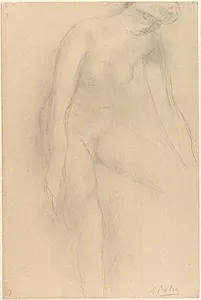
Standing Female Nude, Bending Forward
n.d.
Medium
Graphite, with stumping, on tan wove paper, laid down on buff wove paper
Dimensions
31.1 × 20.6 cm (12 1/4 × 8 1/8 in.)
Classification
graphite
Department
Prints and Drawings
Museum
Art Institute of Chicago
Accession Number
66945
Rights
Public Domain
Art Historical Context
Auguste Rodin's *Standing Female Nude,ending Forward* is a captivating graphite drawing that exemplifies the artist's lifelong fascination with the human form. Created around the late 19th or early 20th centurydate not specified), this undated study measures 31.1 × 20.6 cm and in the Art Institute of Chicago Prints and Drawings collection. Rodin, the pioneering French sculptor behind iconic works like *The Think* and *The Kiss produced thousands of such sketches as preparatory exercises, capturing the dynamic energy and anatomical truth of the body in motion. Rendered on tan wove paper and laid down on buff wove paper for preservation, the drawing employs graphite with stumping—a technique using a soft stump of rolled paper to blend tones, creating velvety shadows and luminous highlights. This method allowed Rodin to model the figure's curves and musculature with sculptural depth, bridging his two-dimensional sketches to three-dimensional bronzes and marbles. The bending pose emphasizes torsion and balance, reflecting Rodin's Impressionist-influenced approach to movement and light, free from classical idealization. For visitors, this intimate study reveals Rodin's genius in distilling raw vitality from everyday observation, inviting us to appreciate the nude not as static beauty, but as a living, breathing force. A testament to his innovative draftsmanship, it underscores why Rodin revolutionized modern sculpture through ceaseless exploration of the figure.
About the Artist
Auguste Rodin · 1840–1917
François Auguste René Rodin (1840-1917) stands as the founder of modern sculpture, transforming the art form from academic tradition into expressive modernism. Born into a working-class Parisian family, Rodin faced early rejection, failing three times to gain admission to the prestigious École des Beaux-Arts. This setback forced him to work as a craftsman for nearly two decades, though his 1875 tr...