
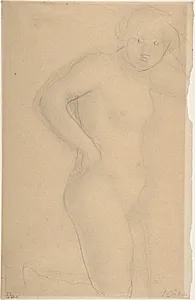
Young Girl Kneeling
1840–1917
Medium
Graphite, stumped on cream paper
Dimensions
Overall: 12 5/8 x 7 11/16 in. (32 x 19.5 cm)
Classification
Drawings
Department
Drawings and Prints
Museum
Metropolitan Museum of Art, New York, NY
Credit
John Stewart Kennedy Fund, 1910
Accession Number
10.66.3
Rights
Public Domain
Tags
Art Historical Context
In the intimate drawing *Young Girl Kneeling*, Rodin captures the delicate form of a nude figure in a moment of quiet vulnerability. Created during the lifetime of the French master (1840–1917), this work exemplifies Rodin's profound skill as a draftsman, even as he is best known for monumental sculptures like *The Thinker* and *The Gates of Hell*. Rodin thousands of drawings, often as preparatory studies or standalone explorations of the human body, reflecting his obsession with anatomy, movement, and emotion in the late 19th and early 20th centuries. Rendered in graphite and stumped on cream paper, the piece measures 12 5/8 x 7 11/16 inches and showcases Rodin's masterful use of tonal modeling. Stumping—a technique of blending graphite with a soft tool—creates smooth, velvety transitions of light and shadow, lending the kneeling girl a sculptural volume that foreshadows his three-dimensional works. This drawing, acquired in 1910 through the John Stewart Kennedy Fund, highlights Rodin's ability to convey tenderness and realism in female nudes, a recurring theme in his oeuvre that challenged academic conventions. Housed in the Metropolitan Museum of Art's Department of Drawings and Prints, *Young Girl Kneeling* invites visitors to appreciate the immediacy of Rodin's gaze, bridging his sculptural innovations with the raw poetry of paper and pencil.
About the Artist
Auguste Rodin · 1840–1917
François Auguste René Rodin (1840-1917) stands as the founder of modern sculpture, transforming the art form from academic tradition into expressive modernism. Born into a working-class Parisian family, Rodin faced early rejection, failing three times to gain admission to the prestigious École des Beaux-Arts. This setback forced him to work as a craftsman for nearly two decades, though his 1875 tr...