
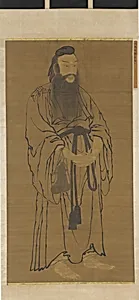
Standing figure of Lü Dongbin
1368-1644
Classification
Painting
Department
Smithsonian Collection
Museum
Smithsonian American Art Museum
Credit
Gift of Charles Lang Freer
Accession Number
F1916.580
Rights
Public Domain
Tags
About this artwork
Lu Dongbing was a late Tang (618–907) scholar who twice failed his examinations for a first-rank degree (jinshi) and then converted to Daoism. Most of Lu’s portraits depict him with a sword, which he used to defend the righteous. Daoism enjoyed great popularity in the Yuan dynasty (1271–1368); it was then that Lu that gained wide favor as an immortal and was chosen as the titular deity of the Quanzhen sect of Northern Daoiam. The present image of Lu, however, emphasizes his genteel identity as a...
Art Historical Context
This elegant portrait, titled *Standing Figure of Lü Dongbin*, hails from China's Ming dynasty (13681644) and captures the revered Daoist immortal in a poised, scholarly pose. Unlike many depictions of Lü wielding a sword to vanquish evil, this painting highlights his genteel identity as a late Tang-era (618–907) scholar poet. Lü Dongbin, who famously failed his imperial examinations twice before embracing Daoism, became a symbol of spiritual transformation and one of the Eight Immortals in Chinese folklore. Created during a period when Daoism flourished—building on its popularity in the preceding Yuan dynasty (1271–1368)—the artwork reflects Lü's elevation as the titular deity of the Quanzhen sect of Northern Daoism. As a hanging scroll or similar painting format common in Chinese portraiture, it likely employed ink and color on silk or paper, techniques that allowed artists to convey moral virtue and intellectual refinement through subtle brushwork and composition. A gift to the Smithsonian American Art Museum from collector Charles Lang Freer, this piece offers visitors a window into Ming-era reverence for cultural heroes who bridged Confucian scholarship and Daoist mysticism, inviting contemplation of immortality's poetic allure.
About the Artist
Unknown
The artist designated as "Unknown" in our virtual museum's collection exemplifies a poignant chapter in art history: creators whose identities have faded into obscurity despite the enduring power of their work. With only one known artwork attributed to them in our holdings, this figure represents countless anonymous hands that shaped visual culture across centuries. Museums worldwide, including th...