
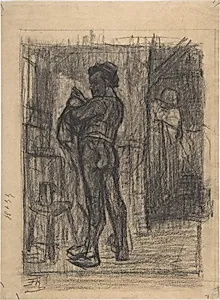
Standing man with beer mugs
Medium
black chalk
Dimensions
11-1/4 x 8-1/4 in. (28.6 x 21.0 cm)
Classification
Drawings
Department
Drawings and Prints
Museum
Metropolitan Museum of Art, New York, NY
Credit
Gift of Dana Broccoli, 1981
Accession Number
1981.1228.8
Rights
Public Domain
Tags
Art Historical Context
Félicien Rops, a pioneering Belgian artist of the 19th century1833–1898), captures everyday revelry in his drawing *Standing Man with Beer Mugs*. Created in black chalk—a medium favored for its soft, expressive tonal range—this intimate sheet measures just 11-1/4 x 8-1/4 inches, allowing Rops to sketch with fluid, spontaneous energy. Likely a study or standalone vignette from his prolific output of drawings, it exemplifies his skill in rendering human figures with a mix of realism and wry observation. Rops, associated with Symbolism and the fin-de-siècle avant-garde, often infused his works with satire, eroticism, and social commentary, collaborating with poets like Charles Baudelaire. Here, the standing man clutching oversized beer mugs evokes Belgian tavern culture and the boisterous camaraderie of working-class life, a motif that contrasts with Rops' more notorious macabre or provocative themes. Black chalk's velvety texture lends depth to the figure's posture and grip, highlighting Rops' mastery of light and shadow in preparatory works that bridged drawing and printmaking. Generously gifted to the Metropolitan Museum of Art in 1981 by Dana Broccoli, this piece invites visitors to appreciate Rops' versatility beyond his scandalous reputation. It reminds us how artists like him transformed mundane moments into timeless glimpses of human joy.
About the Artist
Félicien Rops · 1833–1898
Félicien Rops, born Félicien Victor Joseph Rops on July 7, 1833, in Namur, Belgium, to a prosperous textile manufacturing family, displayed prodigious artistic talent from youth. The only child of Nicholas Rops and Sophie Maubile, he received private tutoring until age ten, followed by education at a Jesuit school in Namur (1843–1848), the Athénée Royal de Namur, and the Academy of Fine Arts there...