
Stanislaw Sobocki (?)
1583
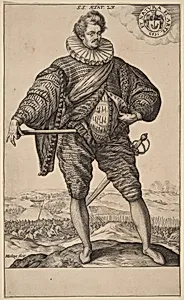
Medium
engraving
Dimensions
sheet: 27.2 × 16.7 cm (10 11/16 × 6 9/16 in.)
Classification
Department
CG-E
Museum
National Gallery of Art, Washington, D.C.
Credit
Andrew W. Mellon Fund
Accession Number
1977.37.1
Rights
Public Domain
Art Historical Context
This elegant engraving, titled *Stanislaw Sobock (?) * and created by the Dutch master Hendrik Goltzius in 1583, captures the poised likeness of its presumed subject against a restrained background. Measuring 27.2 × 16.7 cm, exemplifies Goltzius early prowess as a printmaker in Haarlem during the late Northern Renaissance, a time when engravings bridged the gap between elite painting and wider audiences through affordable reproductions. Goltzius, a leading figure in Mannerism, revolutionized engraving with his innovative techniques, employing swelling line widths and subtle tonal gradations to mimic the volume and texture of oil paintings. Here, the meticulous cross-hatching and fluid contours highlight his technical virtuosity, making the print a standalone work of art rather than mere illustration. Acquired through the Andrew W. Mellon Fund for the National Gallery of Art's collection (CG-E, Prints), it reflects the era's fascination with portraiture as a marker of status and intellect. Though the sitter's identity bears a question mark—possibly a Polish noble or scholar—this piece underscores engraving's cultural role in preserving prominent figures across Europe, inviting viewers to ponder the man's gaze amid Goltzius's shimmering mastery of light and form.
About the Artist
Hendrik Goltzius
Hendrick Goltzius (1558–1617), born near Viersen in the Duchy of Jülich (modern Germany), emerged as the preeminent Dutch engraver of the Northern Mannerist era. From a lineage of artists—his great-grandfather and grandfather were painters in Venlo, and his father, Jan Goltz II, a glass painter—Goltzius began his training under his father in painting on glass. A childhood fire severely deformed hi...