
Star-Shaped Tile
Unknown Artist
A.H. 665 /1266–67 CE
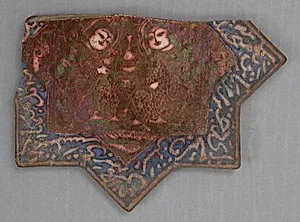
Medium
Stonepaste; underglaze luster- and cobalt painted
Dimensions
H. 4 7/8 in. (12.4 cm) W. 6 5/8 in. (16.8 cm)
Classification
Ceramics-Tiles
Department
Islamic Art
Museum
Metropolitan Museum of Art, New York, NY
Credit
Fletcher Fund, 1971
Accession Number
1971.235.4
Rights
Public Domain
Art Historical Context
This exquisite star-shaped tile, crafted around 1266–67 CE in the Islamic world, exemplifies the pinnacle of medieval ceramic artistry. Made from stonepaste—a innovative composite of quartz, clay, and frit that mimicked Chinese porcelain's translucency—it's adorned with underglaze and cobalt blue paints. The metallic sheen of luster, achieved by applying metallic oxides and firing in a reducing atmosphere, creates a shimmering effect that catches the light, while vibrant cobalt blues add depth. Measuring just under 5 inches high and 6.5 inches wide, its geometric star form was designed for intricate architectural mosaics, evoking the starry vaults of mosques and palaces. Depicting human figures amid architectural motifs, the tile reflects a fascinating blend of figural narrative and ornamental abstraction common in 13th-century Syrian or Egyptian workshops during the Mamluk era. This period followed the Mongol invasions, when artisans revived lusterware traditions from earlier Abbasid and Fatimid innovations, using tiles to embellish mihrabs, domes, and secular buildings. Such pieces transformed walls into luminous tapestries, symbolizing paradise gardens or courtly scenes. Today, housed in the Metropolitan Museum of Art's Islamic Art department, this tile invites us to marvel at the technical virtuosity and cultural splendor of medieval Islam, where geometry met storytelling in enduring splendor.