
State Funeral (Pompe fun
Medium
architecture
Classification
architecture
Department
Smithsonian Collection
Museum
Smithsonian American Art Museum
Credit
Gift of Roger Selchow
Accession Number
1988-102-55
Rights
Public Domain
About this artwork
Research in Progress
Art Historical Context
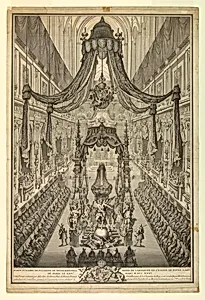
**State Funeral (Pompe funbre)**, created by French artist Charles-Nicolas Cochin the in 1735, offers a glimpse into the grandeur of 18th-century design. Cochin (1715–1790), a leading figure in the Rococo era, was renowned for his intricate engravings, drawings, and theatrical decorations that captured the opulence of Louis XV's. This work, classified as architecture, likely depicts a temporary structure or stage design for a state funeral procession—a common practice in Versailles where elaborate, ephemeral architecture amplified royal pomp and public mourning. As a master of decorative arts, Cochin blended architectural precision with ornamental flair, influencing festival designs and opera sets across Europe. Produced early in his career, it reflects the era's fusion of Baroque monumentality and emerging Rococo elegance, where symmetry and lavish detail served political spectacle. Housed in the Smithsonian American Art Museum through a gift from Roger Selchow, this piece highlights transatlantic exchanges in artistic collecting. Though research continues, *State Funeral* invites us to ponder how architecture shaped collective memory in absolutist France, turning grief into a visually stunning display of power. (198 words)