
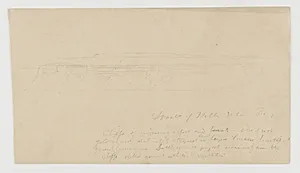
Straits of Belle Isle, Canada
June-July 1859
Medium
landscapes
Classification
landscapes
Department
Smithsonian Collection
Museum
Smithsonian American Art Museum
Credit
Gift of Louis P. Church
Accession Number
1917-4-320-b
Rights
Public Domain
About this artwork
Research in Progress
Art Historical Context
Frederic Edwin Church, a leading figure of the Hudson River School captured the raw majesty of nature in *Straits of Belle Isle Canada*, painted during a sketching expedition in June-July 1859. This American artist (1826–1900) was renowned for his luminous landscapes that celebrated the sublime beauty of the New World, blending precise observation with romantic grandeur. The Straits of Belle Isle, a dramatic waterway between Newfoundland and Labrador, provided Church with a rugged, northern vista—icy waters, sheer cliffs, and vast skies—evoking the untamed wilderness that symbolized America's manifest destiny in the mid-19th century. As a landscape study, the work exemplifies Church's technique of on-site oil sketches, which he used to gather vivid details for larger studio canvases. His Hudson River School style emphasized atmospheric light effects and intricate natural details, influencing generations of American artists. Created amid Church's travels to document remote terrains, it reflects the era's fascination with exploration and national identity. Today, this piece graces the Smithsonian American Art Museum, a gift from Church's son, Louis P. Church, highlighting the family's legacy in preserving his vision of nature's power.