
Street Underpass
1913
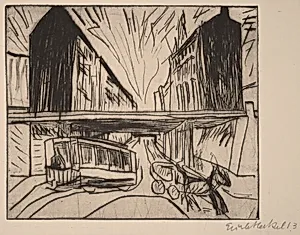
Medium
drypoint in black on buff wove paper
Dimensions
plate: 17 x 20 cm (6 11/16 x 7 7/8 in.) sheet: 23.2 x 34.2 cm (9 1/8 x 13 7/16 in.)
Classification
Department
CG-W
Museum
National Gallery of Art, Washington, D.C.
Credit
Gift of Ruth Cole Kainen
Accession Number
2012.92.271
Rights
Public Domain
Art Historical Context
Erich Heckel's *Street Underpass* (1913) captures the raw energy of urban Berlin through the lens of German Expressionism. As a founding member of Dieücke (The Bridge), a radical group formed in Dresden in 1905, Heckel rejected academic traditions in favor of bold, emotional distortions that conveyed the alienation and vitality of modern life. This drypoint print reflects the group's shift to Berlin around 1911, where artists like Heckel embraced the city's gritty underpasses, factories, and crowds as symbols of industrialization's double-edged sword—progress laced with isolation. The medium of drypoint exemplifies Heckel's mastery of printmaking. Scratching directly into a metal plate with a sharp tool, he created intricate, velvety lines enriched by the burr—a soft, fuzzy edge that holds ink and imparts a tactile intensity rare in smoother etching techniques. Printed in black on buff wove paper (plate: 17 x 20 cm), the modest scale invites intimate viewing, amplifying the scene's claustrophobic tension. Housed in the National Gallery of Art as a gift from Ruth Cole Kainen (Department CG-W), this work stands as a testament to Die Brücke's influence on 20th-century art, bridging raw emotion with technical innovation just before World War I reshaped Europe. Visitors will appreciate its unflinching gaze on the everyday sublime.
About the Artist
Erich Heckel · 1883–1970
Erich Heckel (1883–1970) was born in Döbeln, Saxony, the son of a railway engineer. He attended the Realgymnasium in Chemnitz and went on to study architecture in Dresden, where he encountered the fellow students who would become his closest artistic collaborators. In 1905, together with Ernst Ludwig Kirchner, Karl Schmidt-Rottluff, and Fritz Bleyl, Heckel co-founded Die Brücke — The Bridge — an E...