
Wooden Bridge (Holzbrücke)
1922
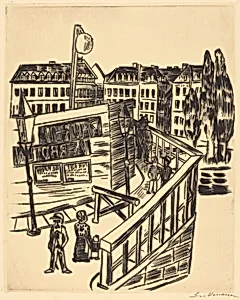
Medium
drypoint
Classification
Portfolio
Department
CG-W
Museum
National Gallery of Art, Washington, D.C.
Credit
Rosenwald Collection
Accession Number
1951.10.238
Rights
Public Domain
Art Historical Context
Step into the evocative world of Max Beckmann *Wooden Bridge (Holbrücke)*, a drypoint print from 1922, now housed in the National of Art's Rosenwald (Department CG-W). Created during the turbulent Weimar Republic in Germany, this work captures Beckmann's mastery as a printmaker amid post-World War I upheaval, when he was grappling with personal and societal trauma after a nervous breakdown in 1918. Beckmann, a pivotal figure in German Expressionism, infused his art with raw emotional intensity and distorted forms to convey inner turmoil and modern alienation. Drypoint, his chosen medium here, involves scratching directly into a copper plate, producing rich, velvety lines with a tactile burr that lends a sense of immediacy and spontaneity—ideal for his bold, angular style. As part of a classified portfolio, *Wooden Bridge* exemplifies how Beckmann elevated printmaking to rival painting, blending architectural motifs like the titular bridge with psychological depth. This intimate yet powerful piece invites reflection on resilience and transition, themes resonant in Beckmann's oeuvre. A testament to his technical innovation and unflinching vision, it remains a highlight for visitors exploring 20th-century graphics.
About the Artist
Max Beckmann · 1884–1950
Max Carl Friedrich Beckmann (1884-1950) stands as one of the most significant German painters of the twentieth century, a complex artist who bridged Expressionism and the New Objectivity while forging a deeply personal visual language. Born in Leipzig into a middle-class family, Beckmann's artistic journey spanned from academic classicism through the traumatic crucible of World War I to a mature s...