
Study for a Border Design
1890/1897
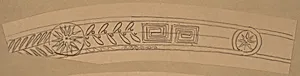
Medium
black conté crayon on tan wove paper
Dimensions
sheet (irregular): 4.9 × 24.4 cm (1 15/16 × 9 5/8 in.) mount: 29.9 × 45.6 cm (11 3/4 × 17 15/16 in.)
Classification
Drawing
Department
CG-W
Museum
National Gallery of Art, Washington, D.C.
Credit
Gift of Mr. and Mrs. Mark Borghi
Accession Number
1995.24.58
Rights
Public Domain
Art Historical Context
**Study for a Border Design by Charles Sprague Pearce (1–1914) is a delicate preparatory drawing from the 1890s, crafted in black conté crayon on tan wove paper. This narrow, irregular sheet—measuring just 4.9 × 24.4 cm—captures Pearce's meticulous exploration of ornamental motifs, likely intended for larger decorative projects such as murals, book illustrations, or architectural embellishments. The elongated format perfectly suits a border study, inviting the eye to trace its rhythmic patterns. Pearce, an American expatriate artist trained in Paris under masters like Jean-Léon Gérôme, blended academic precision with a growing interest in decorative arts during the fin-de-siècle era. Conté crayon, prized for its velvety blacks and subtle gradations, allowed him to achieve depth and texture on the warm tan paper, a popular support for 19th-century sketches that enhanced contrast and tonal warmth. This technique reflects the era's revival of ornamental design amid the Arts and Crafts movement, emphasizing craftsmanship over industrialization. Now housed in the National Gallery of Art as a gift from Mr. and Mrs. Mark Borghi, this modest study reveals Pearce's versatility beyond his renowned genre paintings. It offers visitors a glimpse into the artist's preparatory process, where intricate details foreshadowed grandeur in finished works, celebrating the artistry of the everyday embellishment.
About the Artist
Charles Sprague Pearce · 1851–1914
Charles Sprague Pearce, born on October 13, 1851, in Boston, Massachusetts, grew up in a cultured family immersed in art and exotic imports; his father, Shadrach H. Pearce, ran a business dealing in Chinese porcelain, sparking the young artist's fascination with Eastern motifs. After attending the Brimmer School and Boston Latin School, Pearce worked briefly in the family firm before departing for...