
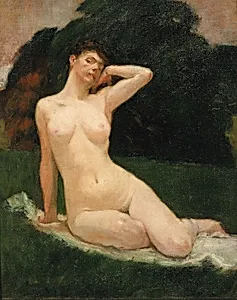
Study for "Evening"
1883
Medium
Painting
Classification
Painting
Department
Smithsonian Collection
Museum
Smithsonian American Art Museum
Credit
Smithsonian American Art Museum, Gift of Mrs. Ambrose Lansing
Accession Number
1983.114.6
Rights
Public Domain
Tags
About this artwork
Kenyon Cox used a dark-haired, voluptuous woman to symbolize Evening in this study for a lost easel painting. When he painted it, Cox was teaching at the prestigious National Academy of Design in New York, which was known for its conservative academic training. He advocated the importance of drawing to his students and even created a seal bearing the motto “Nulle Dies Sine Linea” (No Day without a Drawn Line). (Morgan, Kenyon Cox, 1856-1919: A Life in American Art, 1994)
Art Historical Context
Kenyon Cox's *Study for "Evening"* (1883) captures a dark-haired, voluptuous nude woman in full length, personifying the serene hush of twilight. Created as a preparatory work for a now-lost easel painting, this oil study reflects Cox's deep roots in classical academic tradition. At the time, the artist was an influential instructor at New York's National Academy of Design, a bastion of conservative training that emphasized rigorous figure drawing and idealized beauty drawn from antiquity. Cox championed the discipline of daily drawing practice among his students, even designing a seal emblazoned with the Latin motto *Nulle Dies Sine Linea*—"No Day without a Drawn Line." This study exemplifies his commitment to precise line work and anatomical mastery, blending sensual realism with symbolic allegory. As part of the Smithsonian American Art Museum's collection (gift of Mrs. Ambrose Lansing), it offers a glimpse into late 19th-century American art's dialogue with European academicism, bridging personal expression and pedagogical ideals. Though the final *Evening* painting is lost, this surviving study endures as a testament to Cox's skill in evoking mood through form and shadow, inviting viewers to ponder the timeless allure of evening's embrace.
About the Artist
Kenyon Cox · 1856–1919
Kenyon Cox (1856–1919) was born on October 27 in Warren, Ohio, to General Jacob Dolson Cox, a prominent politician and Civil War veteran, and Helen Finney Cox. Despite fragile health, young Cox pursued art at the Art Academy of Cincinnati before advancing to the Pennsylvania Academy of the Fine Arts in Philadelphia. In 1877, he traveled to Paris, studying first under Carolus-Duran, then at the Éco...