
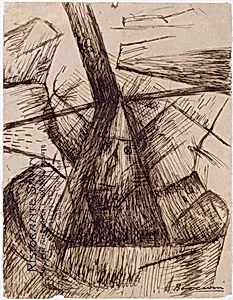
Study for "Fusion of a Head and a Window"
1912
Medium
Ink on paper
Dimensions
5 11/16 × 4 3/8 in. (14.4 × 11.1 cm)
Classification
Drawings
Department
Modern and Contemporary Art
Museum
Metropolitan Museum of Art, New York, NY
Credit
Bequest of Lydia Winston Malbin, 1989
Accession Number
1990.38.26
Rights
Public Domain
Tags
Art Historical Context
Umberto Boccioni’s *Study for “Fusion of a Head and a Window”* captures the restless energy of early twentieth-century modernism. Created in 1912 as a preparatory drawing, this small ink-on-paper work explores the merging of human form and architectural elements, reflecting the artist’s interest in breaking traditional boundaries between figure and space. The compact dimensions—just under six inches high—invite close looking, revealing rapid, expressive lines that distill a head into geometric fragments. As a drawing rather than a finished painting, the piece offers a window into Boccioni’s working process. Ink allowed for quick, decisive marks that emphasize movement and abstraction over realistic detail. The tags “Heads” and “Abstraction” underscore how the study reduces facial features to dynamic shapes, hinting at the larger canvas it preceded. Today in the Metropolitan Museum’s modern collection, this intimate work reminds visitors of the experimental spirit that shaped twentieth-century art. It stands as both a technical exercise and a conceptual leap toward new ways of seeing the human presence in an increasingly mechanized world.
About the Artist
Umberto Boccioni · 1882–1916
Umberto Boccioni (1882–1916) was an Italian painter and sculptor who became the leading artist and principal theorist of the Futurist movement. Born in Reggio Calabria, he studied in Rome under the Divisionist painter Giacomo Balla and was deeply influenced by Post-Impressionism before encountering the ideas of Filippo Tommaso Marinetti, whose 1909 Futurist Manifesto catalyzed Boccioni's artistic ...