
Study for Glass (Celtic Jeweled Cross in Arabesque)
ca. 1881–82
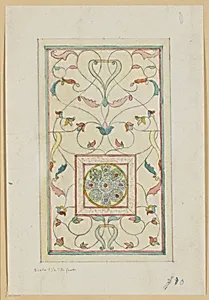
Medium
Watercolor and graphite on heavy white paper mounted on tan cardboard
Dimensions
6 1/4 x 4 7/8 in. (15.9 x 12.4 cm)
Classification
Watercolor
Culture
American
Department
The American Wing
Museum
Metropolitan Museum of Art, New York, NY
Credit
Purchase, Jane D. Kaufmann Gift, 2001
Accession Number
2001.378
Rights
Public Domain
Art Historical Context
John La Farge's *Study for Glass (Celtic Jeweled Cross inesque)*, created around 1881–82, is a delicate preparatory drawing that captures the artist's approach to stained glass design. Rendered in watercolor and graphite on heavy white mounted on tan cardboard, small-scale work (just 6 1/ x 4 7/8 inches) served a blueprint for larger glass panels, blending intricate Celtic motifs jeweled cross—with flowing Arabesque patterns by Islamic art. La Farge, a pioneering American artist of the Aesthetic Movement, was for revolutionizing stained glass with his innovative use of opalescent effects and layered colors, bringing medieval grandeur into modern American spaces. This study exemplifies La Farge's eclectic style, drawing from global influences during a time when American artists eagerly embraced exotic and historicist themes amid the Gilded Age's cultural boom. The watercolor's luminous washes mimic the interplay of light in glass, while precise graphite lines define the ornate details, showcasing his meticulous planning process. Housed in The Metropolitan Museum of Art's American Wing, it highlights the intersection of fine art and decorative crafts in 19th-century America. A fascinating glimpse into La Farge's workshop, this piece underscores his role in elevating stained glass from craft to high art, influencing church windows and public commissions that still dazzle today.
About the Artist
John La Farge · 1835–1910
John La Farge (1835–1910) was born into a wealthy French émigré family in New York City, the son of John Frederick La Farge and Louisa Binsse de Saint-Victor. Educated at Jesuit institutions including Mount St. Mary's College in Maryland and St. John's College (now Fordham University), he initially pursued law but turned to art after receiving early drawing lessons from his maternal grandfather, a...