
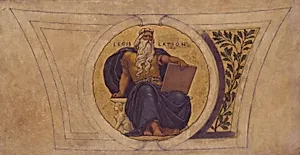
Study for Mosaic, Wisconsin State Capital, "Legislation"
ca. 1913
Medium
Painting
Classification
Painting
Department
Smithsonian Collection
Museum
Smithsonian American Art Museum
Credit
Smithsonian American Art Museum, Gift of Mrs. Ambrose Lansing
Accession Number
1983.114.10
Rights
Public Domain
Tags
Art Historical Context
Kenyon Cox’s “Study for Mosaic, Wisconsin State Capital, ‘Legislation’” offers a fascinating glimpse into the planning of grand civic decoration. Created around 1913, this painting served as a preparatory work for a mosaic that would eventually adorn the Wisconsin State Capitol in Madison. Cox, a leading figure of the American Renaissance, frequently drew on classical traditions to celebrate democratic ideals, and this study reflects his commitment to linking modern government with the timeless imagery of ancient lawgivers. The composition features full-length figures in classical dress, evoking the dignity and authority associated with legislation. By rendering these forms in paint before translating them into mosaic, Cox could refine the balance of gesture, drapery, and architectural scale that would be visible from the Capitol’s lofty spaces. The work’s presence in the Smithsonian American Art Museum, a gift from Mrs. Ambrose Lansing, allows visitors today to appreciate both the finished public art and the careful process behind it. As a study rather than a final piece, the painting reveals Cox’s meticulous approach to public commissions. Its themes of law and civic virtue continue to resonate, reminding viewers how early-twentieth-century artists used classical motifs to express enduring American values.
About the Artist
Kenyon Cox · 1856–1919
Kenyon Cox (1856–1919) was born on October 27 in Warren, Ohio, to General Jacob Dolson Cox, a prominent politician and Civil War veteran, and Helen Finney Cox. Despite fragile health, young Cox pursued art at the Art Academy of Cincinnati before advancing to the Pennsylvania Academy of the Fine Arts in Philadelphia. In 1877, he traveled to Paris, studying first under Carolus-Duran, then at the Éco...