
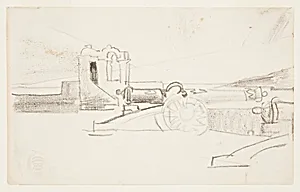
Study for "Searchlight, Harbor Entrance, Santiago de Cuba"
Classification
landscapes
Department
Smithsonian Collection
Museum
Smithsonian American Art Museum
Credit
Gift of Charles Savage Homer, Jr.
Accession Number
1912-12-86
Rights
Public Domain
About this artwork
Research in Progress
Art Historical Context
Winslow Homer, a towering figure in American realism, created this *Study for "Searchlight, Entrance, Santiago de Cuba around 1901. for his powerful depictions of the sea, nature, and human struggle, Homer often drew from dramatic real-world events. This preparatory work references the strategic harbor of Santiago de Cuba, a site during the Spanish-American War of 1898, where U.S. forces blockaded Spanish ships and secured a decisive victory. The "searchlight" evokes the nighttime vigilance of wartime naval operations, capturing a moment of illuminated tension amid the tropical waters. As a study, the piece reveals Homer's meticulous process—likely a sketch or drawing honing composition, light, and form before a larger painting. His realist style emphasized raw natural forces and subtle emotional depth, influenced by his own experiences with maritime themes and earlier Civil War illustrations. Though the medium is unknown, such studies highlight his innovative use of light effects, a hallmark that bridged 19th-century realism with modern impressionistic tendencies. A generous gift to the Smithsonian American Art Museum from Homer's son, Charles Savage Homer, Jr., this landscape classification underscores the artist's enduring fascination with America's expanding horizons. Visitors will appreciate how it connects personal artistry to national history, inviting reflection on war's fleeting yet piercing glow. (198 words)