
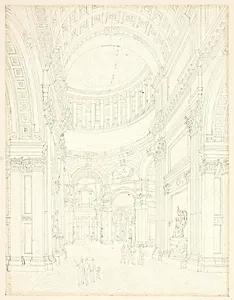
Study for St. Paul's Cathedral, from Microcosm of London
c. 1809
Medium
Graphite on ivory wove paper
Dimensions
25.8 × 19.9 cm (10 3/16 × 7 7/8 in.)
Classification
graphite
Department
Prints and Drawings
Museum
Art Institute of Chicago
Accession Number
113216
Rights
Public Domain
Art Historical Context
In the bustling early 19th-century London by *Microcosm of London* (1808–10), Augustus Charles Pugin *Study for St. Paul's* (c. 1809) offers a preparatory glimpse into the city's architectural splendor. Pugin, a skilled architect and engraver, collaborated with caricaturist Thomas Rowlandson this acclaimed series of aquatint views, blending precise depictions of landmarks like Sir Christopher Wren's iconic Baroque masterpiece with lively scenes of urban life. This graphite drawing served as a foundational sketch for the final engraved plate, highlighting Pugin's role in documenting Regency-era London at a time when the cathedral symbolized national resilience after the Great Fire of 1666. Rendered on ivory wove paper—a fine, smooth support ideal for detailed pencil work—the 25.8 × 19.9 cm study showcases Pugin's masterful draftsmanship. Graphite allowed for subtle tonal gradations, capturing the cathedral's soaring dome and intricate facade with architectural accuracy. As part of the Art Institute of Chicago's Prints and Drawings collection, it exemplifies the preparatory techniques of hand-colored printmaking, bridging raw observation and polished publication. This intimate study invites us to appreciate the behind-the-scenes artistry behind *Microcosm*'s enduring popularity, preserving a vivid snapshot of London's cultural heart.
About the Artist
Augustus Charles Pugin · 1762–1832
Augustus Charles Pugin (1762–1832) was a pioneering architectural draughtsman and engraver whose meticulous illustrations played a pivotal role in reviving interest in Britain's medieval Gothic heritage. Born in France, Pugin relocated to London around 1792, where he quickly established himself as a master of topographical and architectural rendering. Working primarily in engraving and watercolor,...