
Study for "The Martyrdom of Saint Bartholomew"
1635/36
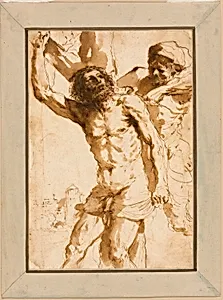
Medium
Pen and brown ink, with brush and brown wash, on buff laid paper, laid down on ivory laid paper, edge mounted under blue wove paper
Dimensions
29.7 × 20.4 cm (11 3/4 × 8 1/16 in.)
Classification
pen and ink drawings
Department
Prints and Drawings
Museum
Art Institute of Chicago
Accession Number
12553
Rights
Public Domain
Art Historical Context
In the bustling world of 17th-century Italian Baroque art, Giovanni Francesco Barbieri, known as Guercino ("the squinter" for his crossed eyes), crafted this dynamic *Study for "The Martyrdom of Saint Bartholomew"* around 1635–36. Guercino, a master from Bologna, was renowned for his dramatic tenebrism—intense contrasts of light and shadow inspired by Caravaggio—and his fluid, expressive drawings. This preparatory sketch captures the gruesome biblical scene of Saint Bartholomew, the apostle flayed alive for his faith, likely as a study for a larger painting or altarpiece, showcasing Guercino's skill in conveying emotion and movement on a modest scale of 29.7 × 20.4 cm. Executed in pen and brown ink with brush and brown wash on buff laid paper, the work exemplifies the Baroque draftman's toolkit. The ink lines define vigorous contours and hatching for depth, while the wash adds volumetric modeling, evoking the saint's tortured form amid swirling figures. Such studies were vital in Guercino's workshop, bridging imagination to finished commissions and revealing his spontaneous genius—often more prized today for their immediacy than polished oils. Housed in the Art Institute of Chicago's Prints and Drawings department, this intimate drawing invites us to witness the raw energy behind Baroque spectacle, highlighting how sketches like this fueled the Counter-Reformation's vivid religious narratives. A testament to Guercino's prolific output of over 100,000 drawings, it offers a window into an artist's mind at work.
About the Artist
Guercino · 1591–1666
Son of a laborer who transported wood. He was called Guercino (squinter), because he was cross-eyed or had a squint in his right eye. Reputedly self-taught early, then an apprentice in the shop of Benedetto Gennari. Patrons included the papal legate at Ferrara and the Archbishop of Bologna. He developed a classical style later in his career. After the death of Guido Reni, Guercino was the leading ...