
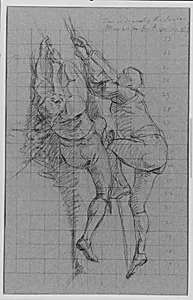
Study for "The Siege of Gibraltar": Figures Scaling Floating Battery; Cannon
1785–86
Medium
Black and red chalk on blue laid paper
Dimensions
17 1/2 x 13 1/4 in. (44.5 x 33.7 cm)
Classification
Drawing
Culture
American
Department
The American Wing
Museum
Metropolitan Museum of Art, New York, NY
Credit
Harris Brisbane Dick Fund, 1960
Accession Number
60.44.18
Rights
Public Domain
Tags
Art Historical Context
John Singleton Copley, renowned American-born painter who later thrived in London, created this dynamic preparatory drawing around 1785–86 as part of his ambitious series on *The Siege of Gibraltar*. This pivotal event during the American Revolutionary War1779–83) saw British forces heroically defend the Rock of Gibraltar against Spanish and French assaults, including innovative "floating batteries"—explosive ships packed with gunpowder. Copley's monumental history paintings celebrated these triumphs, blending neoclassical grandeur with dramatic realism to captivate 18th-century audiences. Rendered in black and red chalk on blue laid paper, the 17½ × 13¼-inch study captures soldiers fearlessly scaling a floating battery amid cannon fire. The blue ground provides a subtle tonal base, allowing the chalks to model muscular figures with vivid highlights and shadows—a technique Copley used to refine compositions before committing to oil on canvas. This intimate sketch reveals his meticulous process, emphasizing raw energy and human endurance. Housed in The Met's American Wing, this work underscores Copley's evolution from portraitist to epic storyteller, immortalizing a turning point in British imperial history while showcasing American artistic ambition on a global stage. A testament to resilience, it invites us to ponder the chaos of battle through an artist's discerning eye.
About the Artist
John Singleton Copley · 1738–1815
John Singleton Copley (1738–1815) was the greatest American painter of the colonial era and one of the finest portraitists in the English-speaking world. Born in Boston, Massachusetts, he was largely self-taught, learning from mezzotint reproductions of European paintings and from his stepfather Peter Pelham, an engraver. By his early twenties, Copley had established himself as Boston's leading po...