
Study from the Nude: Man Seated on Ground, with One Leg Extended
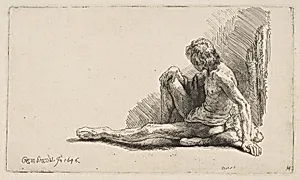
Medium
Etching and engraving; second of two states
Dimensions
Sheet (Trimmed): 4 1/2 × 7 5/16 in. (11.4 × 18.5 cm) Plate: 3 13/16 × 2 11/16 in. (9.7 × 6.8 cm)
Classification
Prints
Department
Drawings and Prints
Museum
Metropolitan Museum of Art, New York, NY
Credit
Gift of Henry Walters, by exchange, 1923
Accession Number
23.51.4
Rights
Public Domain
Tags
Art Historical Context
In 1646, Rembrandt vanijn, the Dutch Baroque master renowned for his dramatic use of light and shadow, created *Study from the Nude Man Seated on Ground with One Leg Extended*. intimate etching and engraving—specifically the second state, a refined version with enhanced details—captures a male figure in a relaxed, naturalistic pose. Measuring just 4 1/2 × 7 5/16 inches (trimmed sheet), its small scale belies the monumental skill in rendering anatomy and texture, hallmarks of Rembrandt's printmaking genius during his Amsterdam years. Etchings like this were Rembrandt's laboratory for exploring the human form, often drawn from life models to master chiaroscuro and subtle tonal gradations. The second state shows his meticulous revisions, deepening shadows and refining lines for greater depth and realism. Male nude studies were essential in 17th-century art training, reflecting Renaissance influences while pushing Baroque expressiveness—Rembrandt's figures feel alive, almost tactile, inviting viewers to ponder the body's quiet vulnerability. Today, this work resides in the Metropolitan Museum of Art's Drawings and Prints department, a gift from Henry Walters in 1923. It exemplifies how Rembrandt elevated printmaking to fine art, bridging studio practice and public appreciation.
About the Artist
Rembrandt (Rembrandt van Rijn) · 1606–1669
Rembrandt Harmenszoon van Rijn (1606–1669) stands as one of the greatest visual artists in the history of Western art and the most important Dutch painter of the 17th century. Born in Leiden to a prosperous miller's family, Rembrandt transformed painting through his revolutionary use of light and shadow, his psychological depth in portraiture, and his elevation of etching to a fine art. His approx...