
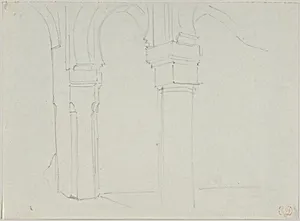
Study of a Moorish Arcade, Spain
May 1832
Medium
Graphite on laid paper
Dimensions
sheet: 6 1/8 x 8 5/16 in. (15.5 x 21.1 cm)
Classification
Drawings
Department
Drawings and Prints
Museum
Metropolitan Museum of Art, New York, NY
Credit
Gift from the Karen B. Cohen Collection of Eugène Delacroix, in honor of Philippe de Montebello, 2013
Accession Number
2013.1135.38
Rights
Public Domain
Tags
Art Historical Context
In May 1832, Eugène Delacroix, the preeminent French Romantic artist, captured this intimate *Study of a Moorish, Spain* during his journey to North Africa and the Iberian Peninsula. Accompanying a French diplomatic mission, Del immersed himself in the vibrant cultures of Morocco and Spain, sketching feverishly to document the exotic architecture, light, and textures that would profoundly influence his later masterpieces like *Women of Alg*. This drawing reflects his fascination with Moorish design—the intricate horseshoe arches and geometric motifs of Islamic Spain, remnants of Al-Andalus's golden age. Rendered in graphite on laid paper, the modest 6 1/8 x 8 5/16-inch sheet showcases Delacroix's masterful spontaneity. His loose, fluid lines evoke the Romantic emphasis on emotion and movement over classical precision, with subtle hatching to suggest depth and shadow in the arcade's rhythmic structure. As a preparatory study, it highlights his innovative approach to on-site drawing, blending acute observation with artistic liberty. Today, this gem from the Karen B. Cohen Collection graces the Metropolitan Museum of Art's Drawings and Prints department. It offers visitors a window into Delacroix's creative process, bridging European Romanticism with the enduring allure of Spanish-Islamic heritage.
About the Artist
Eugène Delacroix · 1798–1863
Eugène Delacroix (1798–1863) stands as the defining figure of French Romanticism and a pivotal bridge to modernism. Born in Charenton-Saint-Maurice near Paris, he came from distinguished lineage—his mother descended from the prestigious Oeben-Riesener furniture dynasty, while persistent speculation suggested the statesman Talleyrand may have been his biological father, a theory supported by physic...