
Study of a Nude Man Holding Bottles
ca. 1715–16
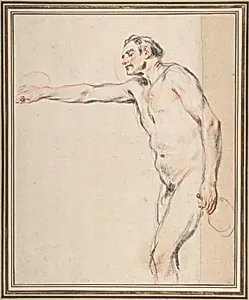
Medium
Black, red, and white chalk.
Dimensions
10 7/8 x 8 7/8 in. (27.7 x 22.6 cm)
Classification
Drawings
Department
Drawings and Prints
Museum
Metropolitan Museum of Art, New York, NY
Credit
Bequest of Walter C. Baker, 1971
Accession Number
1972.118.238
Rights
Public Domain
Tags
Art Historical Context
Antoine Watteau’s *Study of a Nude Man Holding Bottles* (ca. 1715–16) offers a rare glimpse into the French artist’s working process during the early years of the Rococo period. Though best known for his elegant, dreamlike scenes of aristocratic leisure, Watteau frequently turned to life drawing to explore the human form. Here, a muscular male figure is rendered with remarkable sensitivity, his body turned slightly as he grips two bottles—an unusual detail that may hint at a larger, now-lost composition involving everyday or theatrical subjects. Executed in the classic *trois crayons* technique—black, red, and white chalk on paper—the drawing demonstrates Watteau’s extraordinary ability to suggest both volume and luminous skin through delicate hatching and subtle color shifts. The medium allows for soft transitions between light and shadow, giving the figure a lifelike warmth despite its modest scale of roughly 11 by 9 inches. Now in the Metropolitan Museum of Art’s collection, this sheet reflects the 18th-century French appreciation for drawings as independent works of art rather than mere preparations. It reveals Watteau’s deep engagement with the human body and his skill at capturing fleeting poses with both precision and grace.
About the Artist
Antoine Watteau · 1684–1721
Jean-Antoine Watteau, born in 1684 in Valenciennes to a modest family—his father a roofer named Jean-Philippe Watteau—was the second of four sons who displayed an early passion for art. After initial apprenticeship under local painter Jacques-Albert Gérin, he moved to Paris around 1702, working in workshops copying Flemish and Dutch genre scenes. By 1705, he entered the studio of Claude Gillot, ab...