
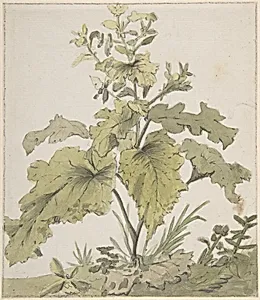
Study of a Plant
Medium
Watercolor over graphite; framing lines in graphite
Dimensions
7 5/16 x 6 3/8 in. (18.5 x 16.2 cm)
Classification
Drawings
Department
Drawings and Prints
Museum
Metropolitan Museum of Art, New York, NY
Credit
Harry G. Sperling Fund, 2007
Accession Number
2007.120
Rights
Public Domain
Tags
Art Historical Context
**Study of a Plant** Christian Wilhelm Ernst Dietrich (2–1774) is a delicate 18th-century drawing that captures the intricate beauty of nature. Created during the Rococo era in Germany, when artists like Dietrich—court painter in Dresden—delighted in elegant, naturalistic motifs, this small-scale work (just 7 5/16 x 6 3/8 inches) exemplifies his skill as a draftsman.oused in the Metropolitan Museum of Art's Drawings and Prints department, it was acquired through the Harry G. Sper Fund in 2007Dietrich employed a meticulous technique: faint graphite underdrawing for precise outlines and framing lines, overlaid with translucent watercolor to evoke the plant's subtle textures, veins, and hues. This layered approach highlights the Rococo fascination with organic forms and scientific observation, bridging art and early botany. Such studies were prized in elite circles for their lifelike detail, reflecting the Enlightenment's growing curiosity about the natural world. Though modest in size, this piece reveals Dietrich's versatility beyond his famous genre scenes and etchings influenced by Rembrandt. It invites visitors to appreciate the quiet poetry of a single plant, frozen in time—a testament to how 18th-century artists transformed everyday flora into objects of wonder.
About the Artist
Christian Wilhelm Ernst Dietrich · 1712–1774
Christian Wilhelm Ernst Dietrich (1712–1774) was a German painter and etcher of considerable versatility, celebrated in his own time for a chameleonic ability to work convincingly in the manner of the great Dutch and Flemish masters of the preceding century. Born in Weimar, he received early training from his father and later studied under Alexander Thiele in Dresden, the city with which his caree...