
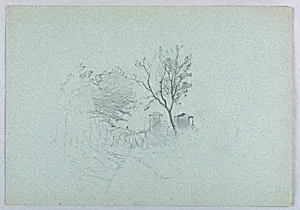
Study of landscape
Classification
landscapes
Department
Smithsonian Collection
Museum
Smithsonian American Art Museum
Credit
Gift of Mrs. Roger H. Plowden
Accession Number
1969-121-60
Rights
Public Domain
About this artwork
Research in Progress
Art Historical Context
William Stanley Haseltine (1835–1900), a leading American landscape artist, created *Study of Landscape* around 1855, his early twenties. Born in Philadelphia and trained at the University of Pennsylvania and Harvard, Haseltine was part of the Hudson River School tradition, which celebrated the sublime beauty of the American wilderness. This period marked his emerging focus on nature's grandeur, influenced by Romantic ideals that viewed landscapes as reflections of divine order. As a "study," this work represents the artist's preparatory practice, common among 19th-century painters honing observation skills for larger canvases. Haseltine's style emphasized luminous light effects and precise geological details, bridging Hudson River realism with the emerging Luminist movement's serene, atmospheric quality. Though the medium remains unknown—possibly oil sketch, pencil, or watercolor—it captures the era's fascination with direct nature studies amid America's expanding national identity. Now in the Smithsonian American Art Museum's Smithsonian Collection, gifted by Mrs. Roger H. Plowden, this piece invites visitors to ponder Haseltine's youthful vision. Research continues, promising deeper insights into his foundational role in shaping American landscape art.