
Study of Ruxton, Colorado
June 7, 1901
Classification
landscapes
Department
Smithsonian Collection
Museum
Smithsonian American Art Museum
Credit
Gift of Thomas Moran
Accession Number
1917-17-82
Rights
Public Domain
About this artwork
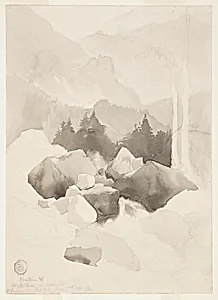
Vertical view of a boulder-filled gorge with a stream in the foreground. Scenic view of mountainside with pine trees.
Art Historical Context
Thomas Moran (1837–6), the celebrated British-born American painter, crafted *Study of Ruxton, Colorado on June 7, 1901, during one of his many journeys through the American West. A gifted landscape artist associated with the Hudson River School Moran was renowned for his vivid depictions of America's majestic wilderness, often sketched en plein air to capture fleeting light and atmosphere. This work, donated by the artist himself to what is now the Smithsonian American Museum, exemplifies his enduring fascination with the Rocky Mountains. The vertical composition draws viewers into a dramatic boulder-filled gorge, where a meandering stream in the foreground guides the eye toward pine-dotted mountainsides. Though the medium is unknown, Moran's characteristic techniques—layered tones evoking depth and luminosity—highlight the sublime interplay of water, rock, and evergreens, inviting contemplation of nature's raw power. As a "study," this piece reflects Moran's meticulous process of observation, honed from expeditions that helped promote national parks like Yellowstone. It offers a window into early 20th-century artistic exploration of Colorado's Ruxton region, celebrating the untamed beauty that defined America's cultural identity.