
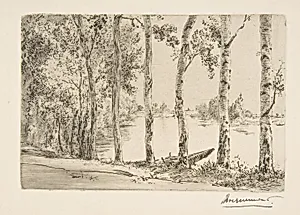
Trembles au bord de la Seine
ca. 1884
Medium
Etching, drypoint; second state of three
Dimensions
Sheet: 9 in. × 10 11/16 in. (22.8 × 27.1 cm) Plate: 3 7/8 × 5 13/16 in. (9.8 × 14.8 cm)
Classification
Prints
Department
Drawings and Prints
Museum
Metropolitan Museum of Art, New York, NY
Credit
Gift of Theodore De Witt, 1923
Accession Number
23.65.92
Rights
Public Domain
Tags
Art Historical Context
Félix Bracquemond's *Trembles au bord de la Seine* (ca. 1884) invites visitors to the tranquil banks of the Seine River, where slender aspen trees—known as "trem" for their quivering leaves—frame a serene landscape dotted with boats. This intimate etching captures the shimmering play of light on water and foliage, evoking the everyday beauty of 19th-century Parisian environs. Bracquemond, a leading French printmaker and etcher, was a key figure in reviving the medium during the Impressionist era, blending precise observation with subtle atmospheric effects. Rendered in etching and drypoint—this is the second state of three—the work showcases Bracquemond's masterful technique. Etching allows for crisp, incised lines etched into a copper plate with acid, while drypoint adds velvety burrs from direct needle scratches, lending a soft, textured richness to the trees and river reflections. At just under 4 by 6 inches on the plate, its small scale intensifies the viewer's immersion in nature's quiet drama. A gift to the Metropolitan Museum of Art in 1923 from Theodore De Witt, this print highlights Bracquemond's influence on modern printmaking and his appreciation for Japanese aesthetics in European art. Stroll along the Seine in your mind's eye and feel the aspens sway!
About the Artist
Félix Bracquemond · 1833–1914
French, Paris 1833–1914 Sèvres